FreeMax Weight Releasers Review – Great, But Also Not – 2026
Last updated on May 6th, 2026 at 09:10 am
I attended HomeGymCon 2025 and came home with one of the more unique pieces I saw there, the Freemax Weight Releasers. When we walked to the booth I had no idea what to expect, and was instantly intrigued. He said he had Weight Releasers, which I had seen before but never used. When he set them up I wasn’t sure he knew what a weight releaser was. They are typically these huge metal hooks that load up on a barbell and help you overload the eccentric for a single rep. These were different.
We’ve used the FreeMax Weight Releasers for several months before putting my thoughts together. Actually, I finished my write up and then sent them to my dude Gaglione Strength so he could do a full review as well. He is a geared lifter and coach, and has experiences where I don’t, so I thought his opinions and ideas would be a good compliment to mine, to help you make an informed decision.
John and I did not share notes at all before publishing our projects, so his views are his and his alone, and mine are mine and mine alone. Hope this helps you figure out if the FreeMax Weight Releasers are right for you, or not.

Transparency Note
The Freemax Weight Releasers were given to me for free at HomeGymCon 2025. There were no strings attached, but obviously their goal was that I would like them, promote them, and hopefully you’d buy them.
I wasn’t given any affiliate link or anything, so there is nothing here but a free product that looked interesting and me doing my thing.
FreeMax Weight Releasers Overview

The Freemax Weight Releasers are a complete rebuild of the typical weight releasers of years past. What was once a large metal hook, is now a barbell strap and loading pin that disconnects to “release” the weight.
They are meant to work for what is called an overloaded eccentric, where the lowering portion of a lift is heavier than the lifting portion. The concept is that you can handle more weight in the eccentric, than the concentric, so you are tapping into more muscle recruitment, expanding the nervous system’s ability to fire on all cylinders, and trying to take advantage of every last possible piece to the muscle and strength building formula.
The loading pin is 4″ long, which should allow a solid 2 plates. The site doesn’t have a weight capacity, but the items themselves say 100lbs per side, though I was told they have been tested MUCH higher. The owner told me that they were tested to 2000lbs on the hanging loop itself, where the cam buckle is rated to 1500lbs, the webbing to 3000lbs, and the carabiner to 800lbs. So I guess we are good for 800lbs if we happened to get there.

The strap that goes on your bar insures that you don’t have any damage to your barbell, a nice touch. And in their demo, there was VERY little noise to the drop. Meaning that this should be something you can do in your home gym, or even a commercial gym, without getting in any trouble or damaging your equipment.
As a space conscious home gym owner, I’m always afraid of adding something new that might take up space and only get used occasionally. Even if this only gets tossed in randomly, it takes up almost no space. So this is an easy add in even the smallest of spaces.
FreeMax Weight Releasers Specs
- Brand: FreeMax
- Made In USA: Yes
- Recommended Weight Capacity: 100lbs per releaser
- Assembly: None
FreeMax Weight Releasers

The entire thing is manufactured here in the US. Which is a big part of why the Freemax Weight Releasers cost nearly $500. Almost positive they are being made in small batches, probably made mostly by hand, which adds up to a high cost. You can see all the intricate pieces in the photo above. There is a spring behind that “clamp” piece as well. So there is a lot going on here beyond what meets the eye from a distance.
Barbell Strap

The strap wraps around your barbell sleeve, and will remain there throughout your set. In testing, these seemed to stay in place fairly well, even without collars holding them there. So you aren’t likely to have this sliding off on one end of the bar, or falling off entirely during a set. The strap also has the “hook” that connects to the drop portion.
Adjustable Strap

Since you need a longer strap for squats than you do bench, the Freemax Weight Releasers need a way to adjust their length. This piece works similar to a tie down strap for a truck. I’m 6ft tall, and this was enough for both bench and squats with some room to spare. So unless if you are well outside of an average human being, you should be good to go here.
I was originally going to try and replace the included carabiner with one of my own carabiner preferences. But the eyelet proves to be a troublemaker there, and they specifically used this so there was NO additional movement on the strap. So while I would prefer a carabiner with no teeth and some better overall design choices, this is the right solution for the job at hand.
Loading Pin
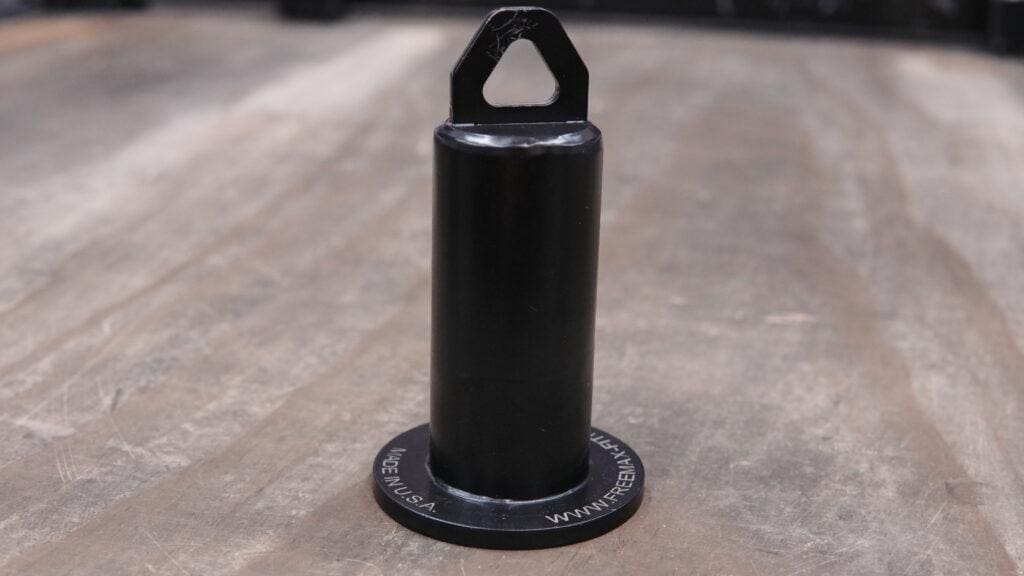
The loading pin is pretty straight forward on the FreeMax Weight Releasers. It clips into the carabiner at the end of the adjustable strap, and you can load up your plates. In testing I haven’t seen any considerable scratches, dents, dings, or anything else. The loading pin works, and since it is so short, it fits well and stores away fairly easily.
Notes On Build From The FreeMax Team
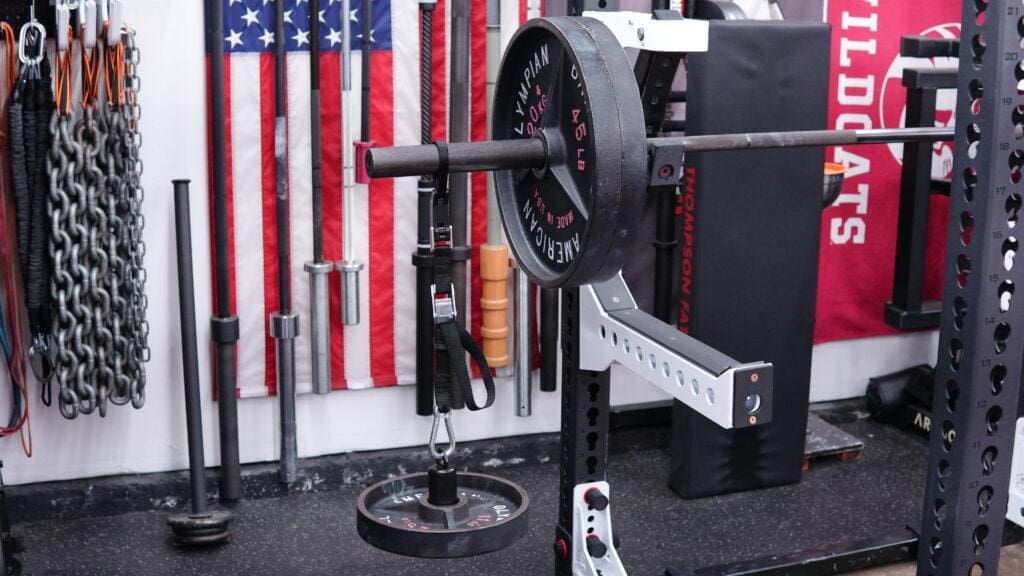
I had some questions on the FreeMax Weight Releasers, and the team gave me a bunch of answers.
Notice the space between the connecting link and the releaser body. This ensures the connecting link cannot twist as it is ejected. Looking at the connecting link—those are hardened and ground alloy steel dowel pins that are press fit into the metal side plates—those holes are bored and reamed to size on both side plates, and the pins pressed into holes smaller than the diameter of the pins. Notice the square shoulders as the pins meet the side plate—this keeps the link in its attachment point on the releaser and prevents it from twisting.
Also, those square shoulders where the webbing attaches, keep the webbing from wandering up the side plate of the link connector, and it functions like a hinge as it is ejected.
That little ejector with spring attached to it? Has 4 different machining setups because of the shape. The releaser itself is hard coat anodized, much more durable than regular anodizing, and more expensive. The link connector is nickel plated, not zinc (zinc is much cheaper).
The weight pins are coated inside and out—I make them hand spray the inside of the pin before they powder coat, because you can’t shoot powder coat into a closed ended tube.
Does Eccentric Overload Even Work?
This might be the most important piece to the puzzle. Because even if the FreeMax Weight Releasers are AWESOME, if Eccentric Overload doesn’t work, it doesn’t matter. Lets start with my experience, then I’m going to jump into a piece from some people that know more than I do.
My Experience With Eccentric Overload

When I’ve seen weight releasers be used in the past, they were almost always used for bench. I think part of this is because of the way geared lifters operate, where the suit requires you to control and own that bar all the way to the touch point, and then you need to EXPLODE up to take advantage of the suits rebound effect.
With a weight releaser, you are doing a very similar thing. Controlling that weight on the way down, the weight drops off the bar, and then you EXPLODE up.
For a raw bencher, this is a little different. I never struggle to lower the bar to my chest, but I definitely struggle to get it off my chest or to finish the lockout. So weight releasers aren’t attacking the hardest part of the bench press for a raw bencher. And considering how JuggernautAI has me do VERY few singles, the weight releasers only work for the first rep, every rep after that is a “normal” rep.
There are some arguments that weight releasers can help prime the nervous system for bigger lifts. The idea is that if you load 300lbs on the bar with 50lbs on the weight releasers, your first rep starts with your system FEELING 350lbs. So, your nervous system starts preparing for that 350lb lift.
You lower 350lbs, 50lbs drops off, but your body doesn’t really know this. So it puts 350lbs worth of effort, into lifting 300lbs worth of weight. The concept makes sense to me, as I feel like when I have used chains before, this same effect happens. You have an extra 120lbs at the top of the lift, that drops off at the bottom. But the lift EXPLODES up because of that initial overload.
I say all of this, to paint a mixed bag of expectations and reality, that I’m not positive works, but I’m also not positive that it doesn’t work.
Stronger By Science

Stronger By Science is a gut check on a regular basis for those of us who like shiny things. They regularly put out fantastic articles based on research and analysis, and they just so happened to release a recent one on Eccentric Overload.
Side Note – If you aren’t subscribed, you should be. Check out the Stronger By Science Newsletter.
I’m going to take some pieces from the article, but you should probably read the entire thing. They cover the fact that there are some misunderstandings around eccentric overload and the proper application. They also EXPLICITLY call out Weight Releasers in the article. Good news for us.
In the present study by Yue and colleagues, participants performed 4 sets of 6 reps on squats. One group of subjects performed traditional squats, one group used weight releasers on 2 reps per set, and one group used weight releasers on all 6 reps. When using the weight releasers, the eccentric was loaded at 120% of 1RM, whereas the concentric was loaded with 75% of 1RM. Essentially, this design allowed the researchers to compare varying degrees of eccentric overload. Oddly enough, the researchers measured rectus femoris cross-sectional area, which likely wasn’t the best choice given the biarticular nature of the muscle. However, in spite of the strange choice of measurement site, eccentric overload training led to greater growth.
They go on to talk about two additional studies that had similar results in hypertrophy and strength gains.
So this is a win in one aspect for Eccentric Overload. That said, I’m not entirely positive how they managed to use weight releasers for 6 reps of a 6 rep set in that study. As a home gym lifter, you aren’t likely to have a training partner (let alone two) there to help you load and unload and reload the weight releasers. So I think this would be difficult with the FreeMax Weight Releasers.
Which takes us into their next discussion point.
Even if accentuated eccentrics did yield a small hypertrophy edge, the practicality problem remains. Performing them safely for free-weight movements requires weight releasers… and ideally one or two partners to reattach them between reps. That’s cumbersome enough in a powerlifting gym, let alone a commercial one.
So, from a hypertrophy perspective, accentuated eccentric loading is a solution in search of a problem. The available research suggests that normal, traditional training already exposes the muscle to sufficient eccentric stimulus.
So the answer is… Eccentric Overload seems to have mixed results. It can work, but not likely a huge improvement. And the effort to get there, the tools required, and the team around you to get it done effectively, is likely out of reach and excessive for the small marginal improvement over more traditional efforts.
Because remember, items like the FreeMax Weight Releasers ONLY work on the first rep if you are by yourself. So that adds an extra wrinkle into the equation. Does a little more weight on a single eccentric translate into anything meaningful over the course of a training block, two, three, a full year?
FreeMax Weight Releasers Performance

Earlier this year I ran a Bench Spec program through JuggernautAI. It was part of my Adjustable Bench Showdown project, but it gave me an awesome opportunity to mix in the FreeMax Weight Releasers during my multiple bench sessions every week. I also had one squat session a week, so I got some love there too.
I didn’t use them for EVERY single set, but I did make an honest effort to grab them for warm-up sets, working sets, with different intensities, and more. Trying to get a feeling for how these worked (or didn’t) in a normal workout program. Keep in mind, I was building towards the Fall Garage Gym Competition as well, so while I was testing a number of benches, I was also focused on trying to improve my bench press one rep max while maintaining my Squat and Deadlift with minimal volume spent there.
Set-Up

Loading a weight on the pin is easy. It works like any other loading pin. The carabiner worked well, the strap system connecting to the bar was solid. But the Adjustable Strap was a consistent struggle.
First, you need to get the left and right sides set up equally. There are no markings on the straps to let you know that it is set at 1 inch, 5 inches, or 5.245 inches. So you have to set the bar up on your safeties that need to be a little high, set the straps to the desired length, test them on each side, and then get to work.
So you need to remember to do this BEFORE loading the bar, otherwise that is a difficult process. But there are a few hiccups to what is already not a great solution.
You need to do this for Bench and for Squat. Meaning every time you will need to adjust the straps appropriately. You could buy additional straps, or their recommendation is to mark the strap with some tape or a paint marker. But that gets us into another issue.
What about specialty bars? My cambered bar, football bar, and straight bar all have different range of motions for bench. The same goes for my cambered bar, safety squat bar, and straight bar for squat.
So we either need to buy half a dozen straps and mark them appropriately, make half a dozen marks on the straps, or accept that we only use the FreeMax Weight Releasers for straight bar work. I’m not a huge fan of any of those answers.
For a product that has such attention to detail in the majority of the construction, they seemed to skip a very important piece to the puzzle. Your typical weight releasers work off pins for adjustments, so left and right is consistent EVERY SINGLE TIME. You can make notes in a spreadsheet or piece of paper about which one works for which bar and exercise, and be working quickly.
The FreeMax Weight Releasers seemed to trade the bulk of a weight releaser, in favor of a less than ideal set up. I get the idea, it just didn’t pan out for me.
Struggles In Use

With the struggles of the set-up, came one more problem. In the clip above I lowered the bar down like normal, and had a pretty funky hiccup.
The FreeMax Weight Releasers did their thing on the left side, but NOT the right side. You can see in the clip that this caused an unexpected dump on the safeties. Luckily no injury or issues, but definitely not something I wanted to experience again.
This wasn’t the first set of the day, nor was it my first use of the FreeMax Weight Releasers. But it was definitely my last. If you watch the clip, I don’t see any glaring issues or reasons for this. The bar wasn’t overly lopsided off my chest. I don’t see any tangles, twists, or anything like that. The FreeMax Weight Releasers just seemed to not work for that one set.
Other Applications
When we had the team demo the FreeMax Weight Releasers at HomeGymCon, they were explaining a drop set concept. The idea was that you could rep out your set, let them hit the ground, and bang out a few more reps with less weight. My struggle here is that you essentially have to cut your reps short on the range of motion to keep the weight releasers from touching and engaging until you are ready to have them do their thing.
This was a similar issue we had with our Performance Pins. You have to be very conscious of your range of motion otherwise that drop set can kick in too early, or not at all, and completely ruin a set. Cool idea, but not exactly perfect.
Should You Buy The FreeMax Weight Releasers?

The FreeMax Weight Releasers are a very mixed bag for me. Some of the parts, like the actual releaser itself, clearly make up the VAST majority of the price tag. The machined metal and attention to detail is incredible. It is so precise it almost looks like a car part. This piece would make even the most picky of home gym owners happy.
But the strap system for the FreeMax Weight Releasers is completely overlooked. The answer of “mark the straps with a pen or tape” is… Well, I’m not accepting that as a valid answer. We went from every detail accounted for, to no details accounted for. Like they spent their entire budget addressing everything else and had to tap out on the strap.
Considering that one set where the system failed me, which could be a MAJOR injury waiting to happen, I’m not sure I’m on board with the FreeMax Weight Releasers as a whole. So even the piece where they spent so much time and effort to perfect, didn’t work well enough for me to feel comfortable using this consistently by myself. And because of my struggles, I never had anyone else in my space handle the FreeMax Weight Releasers either.
And I think, which is common in the world, they are trying to push these as something more than what they are. The drop-set concept is flawed in a number of ways. I get the idea, but I’m not cutting my reps short for the sake of a drop set.
When I shared these originally to r/HomeGym, the feedback was fairly consistent. Probably the easiest way to explain the feedback was… “I can think of 1000 things I’d rather spend $500 on.” Yeah, for $500 you could get a bench, a couple different specialty bars, some nice cable attachments, a decent chain set… You get the idea.

I got a chance to meet my guy SmokinHawk from my old BodyBuilding.com Forum days at HomeGymCon. I talked to him about the FreeMax Weight Releasers because I knew he had designed some stuff for Rogue. He actually designed Rogue’s weight releasers (I believe it is him in the picture below), on top of the fact that he is a MONSTER powerlifter. So his concern around the price of the FreeMax Weight Releasers is another cause for concern.
I think Weight Releasers are a fairly “meh” concept product in the first place based on my experiences and the research. But then you add in some of the struggles I’ve had, and the price tag for these, and I have a hard time recommending the FreeMax Weight Releasers to the majority of people.
Other Options On The Market

A few different companies make the old school style weight releasers including Rogue, Sorinex, and Gorila Fitness. But I haven’t seen anything quite like the FreeMax Weight Releasers option. But keep in mind, the Sorinex offering is just over $200. Literally HALF of what the FreeMax cost. I don’t remember a time in my life where Sorinex was the budget option.
If I had some money to burn on a new toy for the home gym, I’d probably grab some chain sets and mix them into my workouts. You’ll get a similar eccentric overload CONCEPT without the issues of one rep use, no issues with sticking or falling inconsistently, and wide applications that even include deadlifts or curls or anything else you want.
Wrap Up
The FreeMax Weight Releasers have a LOT of attention to detail, that just doesn’t seem to pan out in the real world. And even if it did, that $500 price tag is much too high for something with likely very little carryover to the vast majority of lifters. If you are a geared lifter trying to grab at every last piece of the puzzle, and you’ve got a budget that allows it, then by all means you do you. But for everyone else, I’d go in a lot of different directions before exploring the FreeMax Weight Releasers.
💲Want to snag a set of the FreeMax Weight Releasers? Check this link.

Joe Gray
My name is Joe Gray - aka Gray Matter Lifting - and I've been lifting at home since 2013. In that time I've built a badass gym, deadlifted over 600lbs, helped grow r/Homegym to over 1 Million subscribers, created the Garage Gym Competition and written a ton of posts here on this site. I love the Garage Gym Community... If you do too, I hope you stick around.