REP Calibrated Steel Plates
Last updated on July 2nd, 2026 at 08:00 pm
I’ve been a “powerlifter” for close to a decade. I say that in quotes because I chase down a bigger and badder Squat, Bench, and Deadlift, track my total, and ultimately test those numbers a couple times a year in the Garage Gym Competition. But I don’t actively compete in sanctioned meets. So the idea of owning calibrated plates has intrigued me, but never been something I took the leap on. But the stars have a way of lining up, and we just received the REP Calibrated Steel Plates in the gym, at the same time a few projects were starting to come together. More on that in a bit.
The REP Calibrated Steel Plates are now on the Review Pipeline. Please note that this a LONG term project, hence the completion date far out into the future.

Transparency Note
The REP Calibrated Steel Plates were sent to me for free for sake of review. I also have an affiliate relationship with REP Fitness, and they sponsor my Garage Gym Competition.
Using the link gives me a small kick-back and costs you nothing. The funds help manage this website, my YouTube, and the various things I do in the home gym community. I appreciate your support.
REP Calibrated Steel Plates Overview

I’ve written about weights over the years in a number of fashions. I’ve restored literal thousands of pounds of plates from the used market. I’ve owned bumpers, vintage collectables, matching sets, and just about everything you could own. And I’ve had MOSTLY positive experiences with every plate that has entered (and left) my gym.
But there are a few key aspects that separate the best of the best in terms of weight plates, and everything else on the market. When we get into competition, we can’t just be “good enough”. We need to be exceptional. We need to be pin point accurate. And we need to leave no stone unturned to maximize performance and keep lifters safe while keeping competitive standards uniform across events.
This is where calibrated plates come into the equation. Your normal every day lifter honestly doesn’t need to buy these. In fact, I would greatly recommend you avoid them. They are more expensive, often harder to handle, and provide no additional benefit for anyone who isn’t actively competing and prepping for competition.
But if you are, having the tools at your disposal to practice how you play can be an absolute necessity.
REP Calibrated Steel Plates Specs

- Brand: REP Fitness
- Made In USA: No
- Weight: These come in pounds or kilos, and range from .25kg up to 25kg plates
- Finish: These have an electroless nickel plating that gives it that “matte” finish
- Calibration Standards: These are within 10g of stated weight
- IPF Specs: Yes, these meet IPF Specs
- Warranty: 2 Years
Shipping & Assembly
The REP Calibrated Steel Plates came on a pallet, and each plate (except for the smallest ones) was individually wrapped and packed. You had a cardboard box, with teflon tape holding it together, alongside the plastic cinch staps. Inside was a double walled foam insert, taped around all sides, with the plate inside of that.
It was honestly a MASSIVE workout to get these unpacked and cleaned up. But they all got delivered in perfect condition. So kudos to REP.
REP Calibrated Steel Plates Features

The REP Calibrated Steel Plates we received are in metric, i.e. Kilograms. This is because the VAST majority of competitions are going to compete with KG plates. Honestly, outside of some local meets, I don’t think anyone is using pounds. While I use pounds for my daily drivers, because Americans do that for some reason, I would highly advocate to grab the KG version of these plates.
We’ve got 25kg reds, 20kg blues, 15kg yellows, 10kg greens, 5kg whites, and then change plates that include 2.5, 1.25, .5, and .25 kg. The only thing we don’t have from REP here, is a set of competition collars. Luckily I have an older pair of IVANKO Comp Collars that we’ll be using when the time comes.
Thickness

The first item that is pretty apparent in terms of differences between normal plates and competition plates, is the thickness. The REP Calibrated Steel Plates pictured on the right are a red 25kg, which comes out to a little over 50lbs. The black plate on the left is a 45lb plate. You can see we measure in around HALF of the thickness, while actually weighing more. Which is a wild thing.
This has two major impacts. First, is that for the LARGEST of lifters, we can fit more weight on the bar. My 630lbs deadlift PR, with my plates, gets pretty close to filling up the sleeves. I believe I can fit another pair of 45s, and then I’m out of room, depending on the collars of choice. And remember that while 630lbs is a solid attempt, that isn’t even close to any kind of a record breaking pull. With these red 25kg plates, we’ve got plenty of room.

Second, and this is one of the main reasons why actively competing lifters should be considering these for their own gym, is the distribution of weight on the bar. If we use a deadlift bar for our deadlifts, we are actively trying to take advantage of the “whip” in the bar, to give us a slightly higher starting position, which can translate into more weight on the bar (less range of motion = good for powerlifting). The further out we can push that weight towards the end of the barbell sleeves, the more bend we get into the bar. This is physics working to our advantage.
BUT… if we train at home with wide plates, and show up to a competition using thin plates, that bar might be loaded a solid 6 inches or more less on the sleeves. Meaning that the weight is more centered, meaning we get less bend, meaning our starting position is different. If we have been practicing a deadlift that starts at 6 inches high all off-season and prep, and get to comp and its 4 inches high, that could cause some problems.
This is where practicing with what you play with, starts to make sense, and ponying up for the REP Calibrated Steel Plates might fit the bill.
Weight Tolerance

Most weights you buy are likely going to be “good enough” when it comes to weight tolerance. Meaning, if it claims 45lbs and it is actually 44lbs, that is probably ok. Your average lifter, lifting at home, isn’t going to have any real world issues (or benefits) from being off a bit.
But this doesn’t work well in two scenarios. First, is competition. If one gym has 44lb plates and the next has 46lb plates, but both are stated at 45lbs, we have two different lifters lifting “the same weight” but in reality are not lifting the same weight. If we are trying to compare the biggest lifts from the best lifters, we need consistency. That consistency comes by means of plates meeting the IPF Specs in terms of weight tolerances. So we know that Lifter A and Lifter B, are attempting the same weight, whether it is January or June, California or Kentucky, we are on the same playing field.

The second one, is again for the bigger lifters. Lets use a 495lb lift as our first example. That is 10 x 45lb plates, with the 45lb bar. If 5 of those plates weighs 44lbs and are all loaded on the left side of the bar, while the other 5 are all 46lbs and are loaded on the right side of the bar, the left weighs 220lbs while the right weighs 230lbs. That is a 10lb difference from side to side.
Now consider that people are Squatting, Benching, and Deadlifting in the 1000lb range, so we could DOUBLE that inconsistency fairly easily, and you can probably start to see why this could be a problem. Keep in mind that some plates have been measured over the years at a staggering 5lbs off the marketed weight. This is an extreme, but you get the idea.
So that weight accuracy is important for lifter safety as well as competition standards. Again, another check for the REP Calibrated Steel Plates.
Hole Tolerance

This one is going to be impacted by your plates and your bar of choice, but the hole tolerance is how much “slop” you have between the barbell sleeve and the plate itself in terms of the diameter of the hole. I could make a lot of jokes here, but we’ll leave the R ratings for your brain for a minute.
Any slop in the holes of the plates is going to cause a couple of potential problems. For Deadlifts, the bar is going to sit in the bottom of that hole. If there is slop, you’ll need to pull the bar up into the plates, instead of it fitting snug. If that slop isn’t consistent across plates throughout competitions, we are back to the issue of different lifts for different events. Because every few centimeters of slop, means less range of motion needed to lift that weight up off the floor.
For bench and squats, it creates a slightly different problem. The more movement we have in the system, the more chances we have for that bar and the plates to “bounce” and do a little dance during our lift. The last thing we want is for a heavy squat to shimmy and shake on our backs even slightly, tossing us in the wrong direction.
Whole tolerance is probably the lowest down the line of crucial factors, but it plays a role in the final touches of a quality competition plate. The REP Calibrated Steel Plates have got you covered.
Couple Other Notes

I mentioned the colors, these are IPF spec as well. They help denote to judges and everyone else what weight is loaded on the bar.
There are a few things you might not have thought of though. Specifically for why you SHOULDN’T buy these kinds of plates. The thin diameter, with no lips, hand holds, or anything, makes handling these plates fairly difficult. Now, obviously a 600lb deadlift is heavier than a 25kg plate, but it is the sheer awkwardness of the plate profile that can create problems.
They are also REALLY expensive. Sitting at around $4/lb for these plates on average, even when buying a full set, you need to REALLY think about your needs.
In terms of being a daily driver plate, I think you have some considerations to make and consider. Which is what we are going to talk about when we finish this project.
What We Are Looking For In The REP Calibrated Steel Plates

This project is going to be a little unique. Typically it is me, my wife, my daughter, and some friends handling equipment in our garage and sharing our experiences. The REP Calibrated Steel Plates are about to be sent over to my buddy Darnell for testing. He recently set a California State Record in the Deadlift with an over 700lb deadlift. He also weighs less than me, the bastard. He competed in track and field at UCLA and has since turned his sights on demolishing the powerlifting world.
He has my Combo rack, my full deadlift platform, a few of my leftover odds and ends, and will now be the majority owner of the REP Calibrated Steel Plates. Yeah, sometimes its a good thing to be buddies with me.
Darnell recently had a kid with his wife, so he is all in on the garage gym life, and is looking to keep the wheels on for the next few months and then hit the gas towards bigger and badder. The REP Calibrated Steel Plates are going to play a large role in that.
Darnell is going to spend the next (almost) year using the REP Calibrated Steel Plates, taking notes, and cataloguing his experiences. He’ll note how they handle, how they work in a cold environment, hot environment, and all around in a typical home gym. He has spent the last several years lifting at local gym with nothing but high end competition plates. He’ll make notes about those and their comparisons. Pros and Cons, you name it.

We’ll cap it off by using the REP Calibrated Steel Plates during the 2027 Spring Garage Gym Competition. I will host a Local Meet at my house with a dozen or so local lifters, alongside a full Texas Strength Systems Combo Rack, Deadlift Platform, Texas Deadlift Bar, X-Mark Squat Bar, Ivanko Competition Collars, and of course, the REP Calibrated Steel Plates. I’ll probably snag a legit deadlift jack as well.
My friend Christina from Pull Your Heart Out will be joining us in person in California, and we’ll live stream the entire thing over on YouTube. Christina has been a judge and loader at DOZENS of powerlifting events, so her feedback on the plates will be excellent as well. Expect to see live lifts and commentary, interviews and special guests during the event, coaching feedback and more.

We’ll take a full day of meet recap, experience, and feedback from lifters, loaders, and everyone there on the REP Calibrated Steel Plates. And include it in the full review. So Darnell will share his thoughts on these plates (the professional powerlifter), while I hop in and share mine (the professional reviewer), alongside a legit meet day recap.
This should end with a comprehensive look at how the REP Calibrated Steel plates handle in a true test of their abilities for their prime audience. So you know if these should be your next purchase, or not.
Other Options On The Market
There are a decent chunk of options on the market besides the REP Calibrated Steel Plates. Rogue and Eleiko are arguably your “OG” options at this point. Meaning, they are in the majority of competitions, and you’ll see them across powerlifting gyms all over. They make the most “normal” style with the entire plate coated in the IPF color as well. Which has its pros and cons.
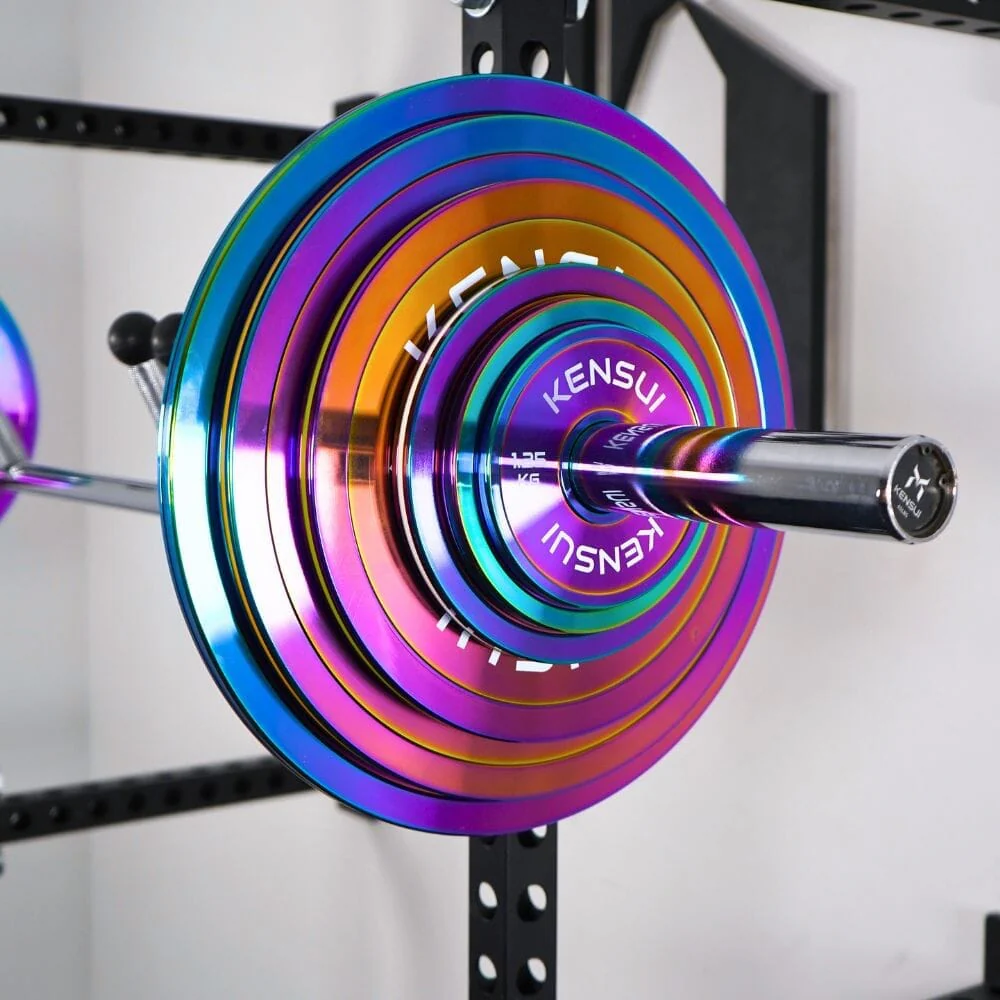
Kensui makes some legit WILD looking options, but I think going with Kensui doesn’t exactly jive with my decision making process for an item like this. If you are buying these for the competition spec perspectives, I think you should go with a company focusing on powerlifting, not on budget barbells. If you want to buy the coolest looking plates on the planet, this by all means, snag a set.
X-Master and Hansu make a bit more sense than Kensui, as they are pushing the envelope for budget and premium powerlifting options.
Ultimately, you are going to need to do some research and choose what fits the budget and purpose for you the most. At the end of this project, I’ll have some more insights to share.
And remember that I think for a normal home gym owner, you should be looking at different weights.
Sign Up For More
✅ I’ll have a full review on the REP Calibrated Steel Plates here and over on my YouTube channel. If you have something specific you’d like answered, let me know.
Want to snag a set of the REP Calibrated Steel Plates? Use this link.

Joe Gray
My name is Joe Gray - aka Gray Matter Lifting - and I've been lifting at home since 2013. In that time I've built a badass gym, deadlifted over 600lbs, helped grow r/Homegym to over 1 Million subscribers, created the Garage Gym Competition and written a ton of posts here on this site. I love the Garage Gym Community... If you do too, I hope you stick around.